Start at the corner
A freight container allows goods to travel by road, rail and sea without being unpacked at each transfer. Its dimensions and structural interfaces create a common language between otherwise different transport systems. ISO 668 addresses the classification, dimensions and ratings of series 1 freight containers. A container ship turns that repeating geometry into a working arrangement of bays, rows and tiers.
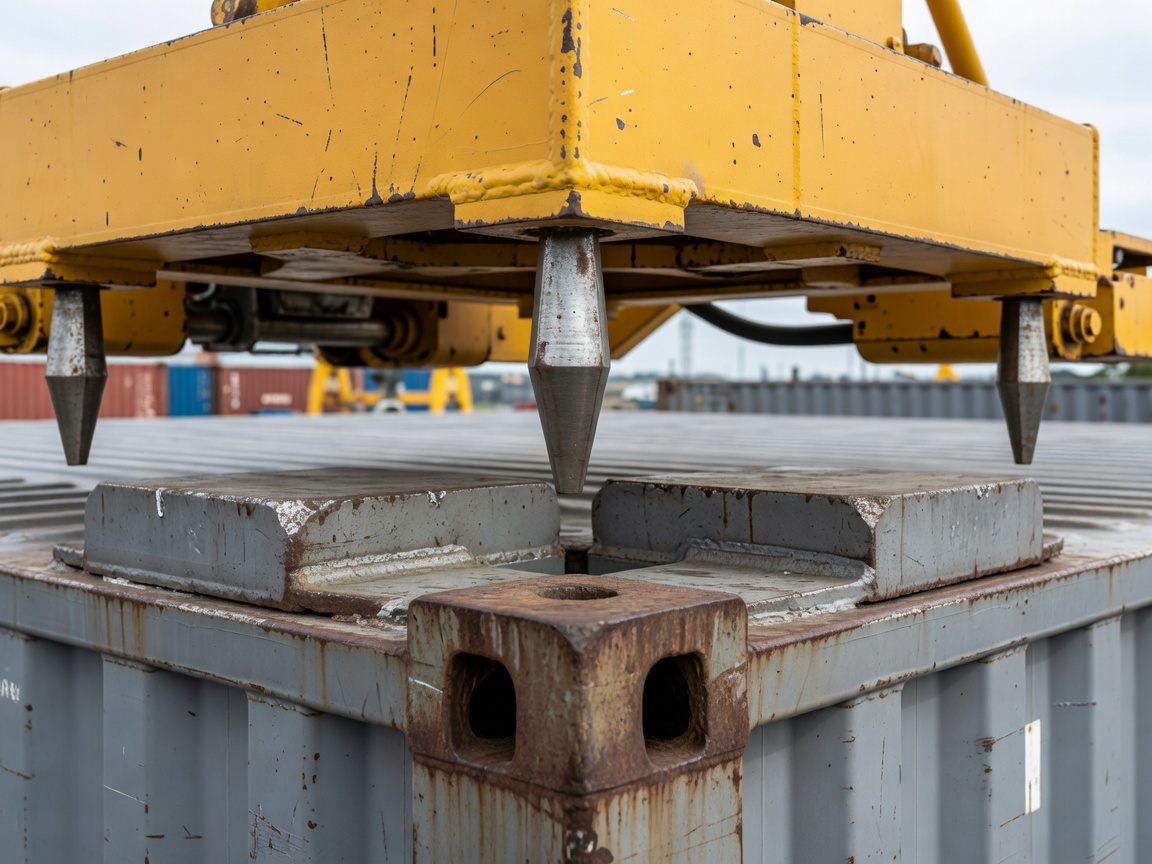
The strong corner fittings are central to the system. A crane’s spreader engages the upper fittings to lift the container. On board, other fittings and securing devices help connect the box to its supports and neighboring containers. The corrugated side panels are visible, but they are not where every lifting or stacking force is intended to go.
The International Convention for Safe Containers, usually shortened to CSC, provides a safety framework for containers used in international transport. A photograph of a box cannot establish its current condition, examination status or suitability for a particular load. Standardized appearance is a starting point, not proof that every box can carry anything.
Give each box a planned position
Below deck, many container ships use vertical cell guides. These steel guides help direct containers into the intended slots and restrain their movement. Above deck, stacks are secured using arrangements that may include twistlocks, lashing rods and turnbuckles. The actual securing system is vessel-specific; it cannot be reconstructed safely from a general diagram.
Loading is more than filling empty spaces. The planner considers container weight, stack limits, the ship’s stability and structural limits, port order and cargo restrictions. A box needed at the next port should not be buried under several boxes staying aboard, unless the resulting extra moves have been deliberately planned.
Refrigerated containers, often called reefers, add electrical and monitoring needs. They carry their own refrigeration machinery but normally rely on an external power supply aboard the ship. Dangerous goods introduce further segregation and stowage requirements under the International Maritime Dangerous Goods Code, or IMDG Code. Two identical-looking boxes can therefore require quite different treatment.
Read capacity without confusing the units
Container capacity is commonly expressed in TEU: twenty-foot equivalent units. A nominal forty-foot container represents two TEU in this counting system. TEU describes an equivalent amount of container space; it does not tell you the weight of the goods or guarantee that every nominal slot can be used on every voyage.
Deadweight is a different measure. It describes the weight a ship can carry within the relevant loading condition, including cargo, fuel, water, stores and other variable loads. A vessel carrying heavy cargo may reach a weight or draft constraint before it fills every available container position. Conversely, light goods can use considerable volume without reaching the same weight limit.
Feeder ships connect smaller ports with larger services and hubs. Larger mainline ships generally depend on terminals with suitable water depth, berth length and crane reach. Rotterdam and Singapore are useful real-world places to explore container terminal operations, but neither port represents one fixed ship size or one universal handling method.
Unloading completes the design
At the destination terminal, the process reverses: securing arrangements are released as required, the spreader engages the container and the crane transfers it ashore. Yard equipment then moves it toward storage, inspection or onward transport. The efficiency of the whole chain depends on coordinating the ship, the berth, the yard and the landside network.
This explains the recognizable silhouette of a container carrier. Large openings below deck, repeating stacks above deck and clear crane access are not decorative choices. They serve a cargo system designed to move standardized units quickly while leaving the goods inside their protective package.
For a reader looking at a port photograph, start with the stack pattern and handling equipment. Then resist the temptation to infer a precise capacity, cargo mix or route. Those details belong in vessel particulars, port information and current operational records, not in the shape of a distant hull.